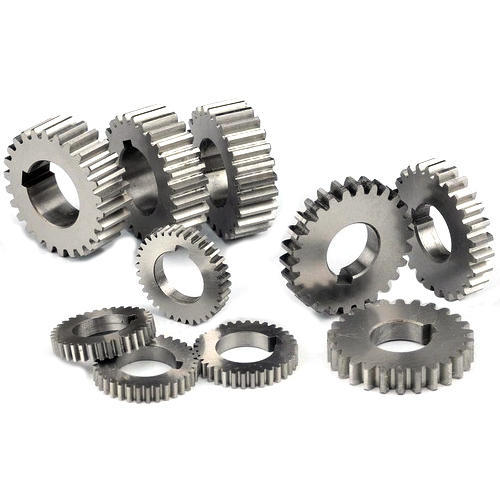
Spur gears and helical gears are the two most common gear types in industrial applications. Both transmit power between parallel shafts, but they differ significantly in performance, noise, and cost. Here's a practical comparison to help you choose.
Spur Gears: Simple and Cost-Effective
Spur gears have straight teeth cut parallel to the gear axis. They're the simplest and most common gear type.
Advantages
- Lower cost — Simpler to manufacture than helical gears
- No axial thrust — Teeth engage parallel to the shaft, eliminating side loads on bearings
- High efficiency — Minimal sliding between teeth means less power loss (up to 99% efficiency)
- Easy to design and replace — Standard profiles, widely available off-the-shelf
Disadvantages
- Noisy at high speeds — Teeth engage suddenly along the full face width, creating impact noise
- Limited load capacity — Only one tooth pair in contact at a time (at the pitch point)
- Not ideal for high-speed applications — Vibration increases with RPM
Helical Gears: Smooth and Quiet
Helical gears have teeth cut at an angle (helix angle, typically 15-30 degrees) to the gear axis. This angled engagement produces smoother and quieter operation.
Advantages
- Quieter operation — Teeth engage gradually rather than all at once, significantly reducing noise
- Higher load capacity — Multiple teeth share the load simultaneously
- Smoother power transmission — Gradual engagement reduces vibration and shock loads
- Better for high-speed applications — Smooth engagement handles RPM well
Disadvantages
- Axial thrust — The helix angle generates a force along the shaft axis, requiring thrust bearings
- Higher manufacturing cost — More complex tooth profile requires specialized cutting
- Slightly lower efficiency — More sliding contact between teeth (still 96-99%)
Side-by-Side Comparison
| Factor | Spur Gear | Helical Gear |
|---|---|---|
| Noise Level | Higher | Lower |
| Load Capacity | Moderate | Higher |
| Efficiency | Up to 99% | 96-99% |
| Axial Thrust | None | Present |
| Manufacturing Cost | Lower | Higher |
| Best Speed Range | Low to moderate | Low to high |
| Vibration | Higher | Lower |
When to Use Each Type
Choose Spur Gears When:
- Budget is a primary concern
- Operating speeds are low to moderate (below 1000 RPM)
- Noise is not a critical factor (e.g., inside enclosed machinery)
- You want to avoid axial thrust loads on bearings
- Simple, easy-to-replace gear sets are preferred
Choose Helical Gears When:
- Quiet operation is important (near operators or in noise-sensitive areas)
- Higher loads or torque must be transmitted
- Operating speeds are high (above 1000 RPM)
- Smooth power transmission is critical (e.g., precision machinery)
- Thrust bearings are already part of the shaft design
Custom Gear Manufacturing
JS Engineering Works manufactures both spur and helical gears in a wide range of materials including EN8, EN24, EN36, and stainless steel. Whether you need a single prototype or a production batch, we can help you select the right gear type and material for your application. Send us your drawing for a detailed quote.